
Newton County Court Records After Arrest
Court records after a jail arrest in Newton County begin after the jail booking record starts the custody trail. The Newton County Detention Center and the sheriff-linked OffenderIndex roster can show arrest date and time, arresting officer, bond, warrant number, charge description, statute, offense type, and a court field when populated. Those fields are useful, but they are not the full court record. A booking charge is the intake view. The case record is the court view, and it may change once the Alcovy Judicial Circuit District Attorney reviews the file.
That split matters in Newton County. Magistrate Court may handle arrest warrants and commitment hearings, while formal criminal cases are searched through the Newton Clerk of Courts online case search or requested from the Clerk. The custody and booking side belongs with Newton County jail inmate records. Booking photos and photo-release limits belong with Newton County jail mugshots. The court record after arrest is the filed case, the charge list, the charge status, hearings, images where available to approved account holders, and the final disposition.
Booking Charge to Court Case
The local path is arrest, jail booking, first court screening, prosecutor review, and then filed court charges. Newton County Magistrate Court's official jurisdiction includes criminal arrest warrants and commitment hearings. After that early stage, the prosecutor decides what charges to file, amend, reduce, dismiss, or decline. The Alcovy District Attorney handles prosecution for Superior Court cases in Newton and Walton counties, so the court record after a Newton County arrest may not match the jail roster line item word for word.
Newton County has no State Court, according to the Alcovy District Attorney's official information. That is a key local point. The DA handles misdemeanors and felonies in Superior Court, including lower-level matters such as traffic or shoplifting and serious felony matters such as murder, rape, and child molestation. Probate Court and Municipal Court prosecution matters are outside that DA role. For a person trying to connect a jail arrest to a court file, this means Superior Court records and DA-filed charges may be the central place to look even for cases that would sit in State Court in some other Georgia counties.
Newton Clerk CMWebSearch is the public case-search entry point for Newton County Clerk records. The public can access Newton County Clerk of Superior Courts civil and criminal records online, and the upgraded system provides images for valid account holders approved by Clerk staff. The Newton Clerk online case search page points users toward that case-search route for civil and criminal records.
Note: Court dates for active criminal cases should be checked with the court or DA because jail roster fields can lag filed case events.
Newton County CMWebSearch Fields
CMWebSearch is different from the jail roster. It is aimed at Clerk records, case access, proceedings, and copies. A person can search by party name, associated party, or exact case number, with filters such as court, division, and filing-date range described in the user guide. Account features matter because images and copy-cart functions require approved access. For certified court and real-estate records, the Clerk also points users toward Georgia eCertification through a separate request workflow.
The CMWebSearch login screen is a fitting visual reference for the court-search part of a Newton County court records after arrest lookup.
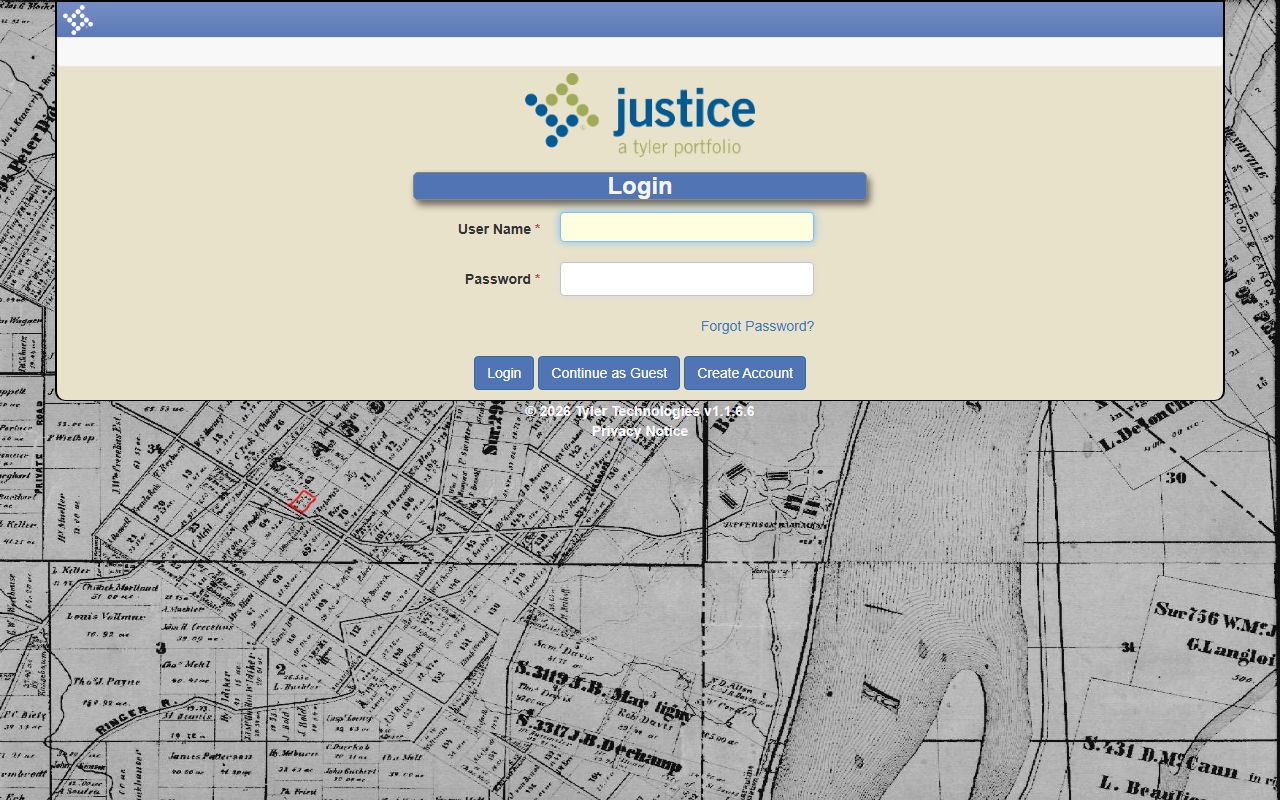
The login and account controls show that public search exists, while document-image access is tied to approved accounts.
| Field / Control | Type | Required | Options / Format Notes |
|---|---|---|---|
| Login | page/control | required for account features | Public access login page shows user name and password. |
| User Name | text | yes | Login field for account-based access. |
| Password | password | yes | Used with an approved account. |
| Create Account | menu action | optional | User guide says Main Menu can create an account. |
| Search By Party | search mode | optional | Search public records by party name. |
| Search By Associated Party | search mode | optional | Examples include prosecutor or attorney. |
| Search By Case Number | search mode | optional | Requires the exact case number. |
| Court / Division | filter | optional | Limits results by court or division where available. |
| Filing Date Range | date range | optional | Limits results by filing date range. |
| Proceedings / Add to Cart | tab/action | n/a | Proceedings and copy-cart functions for available records. |
Newton County Charging Records
After a jail arrest, the charging record can take more than one form. Newton County's documented court path does not reduce every case to one sample form, so the safest way to read a Newton County court record is to separate the arrest entry from the formal charging document. A complaint may support the first charge path. An information can be filed by the prosecutor. An indictment is tied to grand-jury action and is common in serious felony practice. The label used in CMWebSearch or the Clerk file should be read with the case type and court status.
| Document | Who Files or Issues It | What It Does | Newton County Use |
|---|---|---|---|
| Complaint | Officer or prosecutor | States the alleged offense and supports early court action. | May connect the arrest or warrant stage to the case path. |
| Information | Prosecutor | Files a formal charge without grand-jury indictment. | Can reflect the DA's reviewed charge rather than the booking label. |
| Indictment | Grand jury | Accuses a person of one or more charges after grand-jury action. | Often linked with serious felony cases in Superior Court. |
Newton County Charge Status
Charge status is the part of a court record that tells whether the prosecutor-filed charge is still active, changed, or resolved. The DA's filed charge may match the jail roster charge, but it can also replace it. A case can move from pending to amended, reduced, dismissed, nolle prosequi, plea, trial verdict, or another disposition. The status term is more important than the mere fact of arrest because it shows what happened in court after the jail booking.
| Status | Plain Meaning | Why It Matters After Arrest |
|---|---|---|
| Pending | Filed but not resolved. | The case is still active, and future hearings or filings may change the record. |
| Amended | The prosecutor changed the charge. | The court record may no longer match the original booking charge. |
| Reduced | The filed offense was lowered from the original or earlier charge. | A felony-level arrest view may become a lower charge in the court file. |
| Dismissed | The charge ended without a conviction on that count. | The arrest may remain as history, but that charge did not produce a conviction. |
| Nolle Prosequi | The prosecutor declined to proceed. | The state chose not to continue that charge at that time. |
| Conviction | A finding or admission of guilt. | It is not the same thing as arrest or charge. |
Newton County DA Records
The Alcovy District Attorney is central to court records after a jail arrest because that office decides how charges are prosecuted in Superior Court. The Newton County office is listed at the Newton County Judicial Center, Room 313, with phone 770-784-2070 and weekday office hours. The DA page says the office prosecutes all Superior Court cases in Newton and Walton counties. Because Newton County has no State Court, the same office handles misdemeanors and felonies in Superior Court.
The Clerk and DA are not the same office. The Clerk maintains the court record and search access. The DA prosecutes the case. The Magistrate Court role is different again, with arrest warrants and commitment hearings listed in its jurisdiction. That separation helps explain why an arrest can appear first on the sheriff roster, then as a warrant or hearing matter, and later as a formal case with the Clerk. For court dates, the sheriff Jail FAQ directs the public to call the Newton County District Attorney's Office.
Warrants Bond and Arrest
Warrants are a common bridge between law enforcement and court records. The Newton County Sheriff's Office active-warrants page publishes a monthly active warrant list and links to a PDF report. The warrant PDF fields include defendant name, date of birth, warrant number, offense, date received, and issuing officer. A warrant can lead to booking at the Newton County Detention Center, and the later court file may then show the charge status and case activity.
The sheriff's bond-process page describes cash, property, bondsman, transfer, and city bond requirements. Cash bond requires the full cash amount, a local bond fee, and valid government photo ID. Property bond requires Newton County property and listed title, mortgage, tax, and equity documentation. Bondsman or surety bonds are handled by the company, while city bonds for Covington, Porterdale, and Oxford require contact with the city because the city sends the release. Holds and detainers can prevent release even when a bond path exists.
The sheriff warrant page shows the warrant-list format used before some Newton County jail arrests.
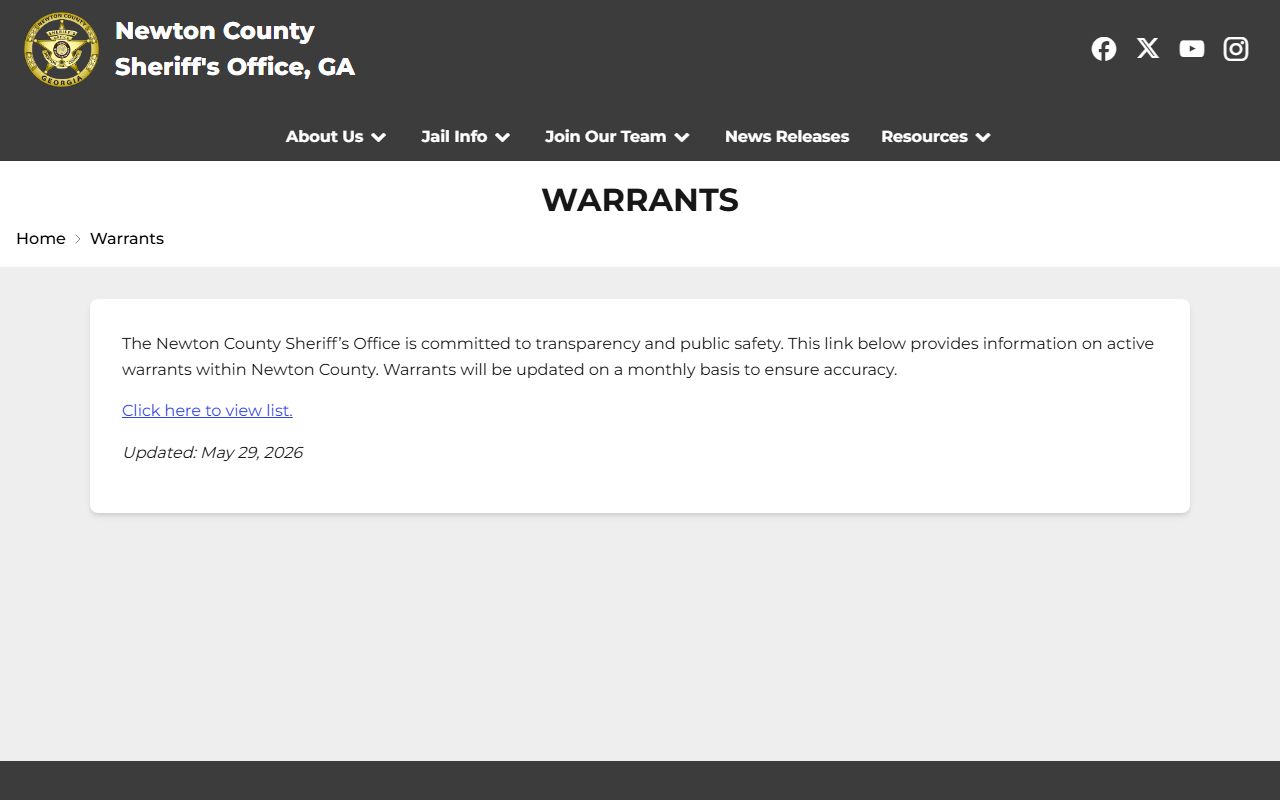
That image fits the arrest-to-court path because warrant details can explain why a booking began before the Clerk case status is checked.
Charge Conviction Sealed Restricted
A Newton County court record after arrest should be read with two comparisons in mind. First, an arrest or charge is an accusation or case event, while a conviction is a final guilt finding or plea. Second, Georgia commonly uses the term record restriction for eligible criminal-history information, even though many people use the word expungement in a broad way. The GBI record restriction page is the statewide reference for that process.
Charge vs Conviction: A charge is an accusation filed or listed in the case. A conviction is a finding or admission of guilt. Do not treat a Newton County arrest or pending charge as proof of guilt.
Sealed vs Expunged: Sealed or restricted records are withheld from some public access. Expunged is a common public term, but Georgia uses record restriction for many eligible records, and eligibility depends on the case result, statute, and agency action.
Newton County Record Access
Georgia's Open Records Act, O.C.G.A. § 50-18-70 et seq., makes public records open unless a specific law, court order, or exemption applies. O.C.G.A. § 50-18-71 covers response timing and fees, and the Newton County Sheriff's Office says it will notify requesters within three business days if responsive records exist and whether they are subject to release. O.C.G.A. § 50-18-72 covers exemptions, including some law-enforcement records. These access rules support requests, but they do not make every court, jail, or investigative record instantly public.
When the online court record does not answer the question, request the exact record from the office that keeps it. For filed charges, proceedings, certified copies, or images, that is usually the Clerk of Courts. For a booking record, jail record, warrant record, or arrest record held by the sheriff, the Newton County Sheriff's Office public-records page and online request form are the documented fallback. Copy fees can apply, and the Clerk's research lists separate copy and certification charges for court records.
Important: A public case lookup is not an FCRA background check and should not be used for employment, credit, housing, insurance, or similar decisions.